









Girma Berhanu (Professor)
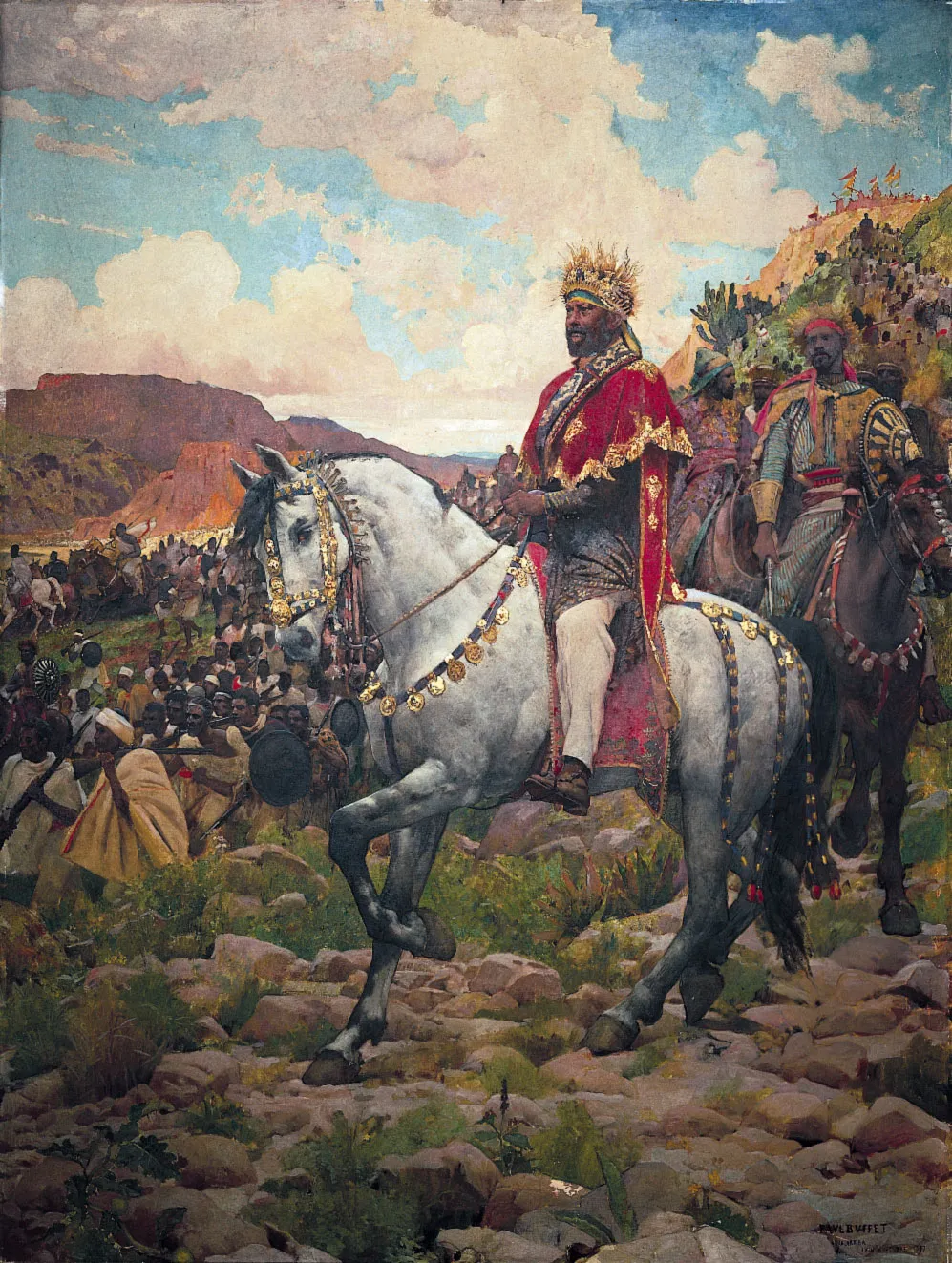
In response to my previous article on Collective Intelligence, some readers suggested that I had praised Atse Menelik II excessively. Such reactions are understandable because Menelik remains one of the most debated figures in Ethiopian history. Like many transformative leaders, his legacy is viewed differently by different communities and historians. Recognizing these differing perspectives is essential for a balanced discussion. Nevertheless, acknowledging complexity should not diminish the magnitude of his achievements.
My central argument remains unchanged: Menelik II deserves far greater recognition as one of the most remarkable statesmen of the late nineteenth and early twentieth centuries.
He governed during one of the darkest periods in African history, when European colonial powers were dividing the continent among themselves. Unlike many African rulers who faced overwhelming military and political disadvantages, Menelik confronted this challenge without the benefit of powerful international allies committed to preserving Ethiopia’s independence. Against these formidable odds, he succeeded in safeguarding the country’s sovereignty—a feat that stands among the most significant accomplishments of any African leader of that era.
His leadership was not defined solely by military success, important though the victory at the Battle of Adwa was. Menelik demonstrated an exceptional ability to combine courage with diplomacy, strategic planning with pragmatism, and determination with patience. He strengthened the Ethiopian state, expanded diplomatic relations, and acquired modern technologies and military equipment at a time when such initiatives required extraordinary foresight and political skill.
Equally important was his vision for national development. He encouraged the construction of roads, promoted the introduction of the railway linking Addis Ababa to the port of Djibouti, supported the expansion of telegraph and telephone communications, introduced modern banking and currency reforms, and laid the foundations for institutions that would shape Ethiopia’s modernization. These initiatives reflected a leader who understood that lasting national strength depends not only on military capability but also on economic development, technological progress, and effective state institutions.
Menelik’s personal qualities also deserve attention. He combined firmness in defending Ethiopia’s interests with an ability to negotiate when negotiation served the national good. He demonstrated resilience in times of crisis, strategic judgment in moments of uncertainty, and a long-term vision that extended beyond immediate victories. These qualities remain hallmarks of effective leadership.
None of this implies that Menelik’s reign was without controversy or criticism. Historical scholarship continues to examine the consequences of state expansion, internal conflicts, and the experiences of different peoples under his rule. These debates are legitimate and should continue. However, a balanced historical assessment should weigh both accomplishments and shortcomings rather than allowing one to erase the other.
When evaluated within the context of his time—rather than by present-day standards alone—Menelik II stands out as an exceptional leader. He preserved Ethiopia’s independence during the height of European imperial expansion, initiated important modernization efforts, and left a legacy that continues to inspire discussions of leadership, national resilience, and strategic vision.
For these reasons, I believe that Atse Menelik II deserves not less praise but more. His achievements were extraordinary not because they were flawless, but because they were accomplished under circumstances that would have overwhelmed most leaders of his generation. His legacy remains a powerful reminder that visionary leadership, strategic thinking, and unwavering commitment to national sovereignty can alter the course of history.
Here are some of his most outstanding achievements:
The question is often asked—sometimes sincerely, sometimes as a political weapon. My answer is another question: By what standard are we judging him? Unless we first agree on the standard, we will simply talk past one another, as though we were speaking different languages.
Some judge Menelik II by twenty-first-century standards of democracy and human rights. Others assess him solely through contemporary Ethiopian ethnonational narratives. Neither approach is sufficient if the goal is to understand history. If we want to determine whether Menelik was a “good ruler,” we must first ask: What constituted good governance during the late nineteenth century, when Menelik reigned?
Defining the Benchmark
Concepts of “good governance” vary across societies and historical periods, regardless of how international organizations such as the United Nations define the term today. The relevant question is therefore not what we consider good governance in the twenty-first century, but how a capable ruler would have been judged between roughly 1880 and 1913.
Representative democracy was rare, and universal suffrage was virtually nonexistent in most parts of the world. This was the height of the colonial era. Human rights, as we understand them today, were not the primary standards by which rulers were evaluated.
A reasonable historical benchmark would include the ability to:
Judged by these standards, Menelik II deserves to be evaluated alongside his contemporaries rather than in isolation.
Menelik II ruled during one of the most unequal and intensely imperial periods in modern history. It was an era defined by global competition among expanding empires and the rapid consolidation of nation-states.
This was the age of:
Across nearly all of these states:
Recognizing these realities does not imply moral approval. Rather, it establishes the historical context within which rulers of the late nineteenth century operated. Any fair assessment of Menelik II—or of his contemporaries—must begin with an understanding of that context.
While Europe was industrializing and expanding, Africa faced the Scramble for Africa. To contrast, in 1880, approximately 80 percent of Africa remained under African rule. By 1914, only two independent states remained:
Nearly every major African kingdom fell. The Ashanti, Dahomey, The Ndebele Kingdom, Samori Touré’s empire. All were conquered despite determined resistance.
Menelik’s Ethiopia survived.That fact alone makes him one of the most consequential African rulers of his generation.
Measured against the benchmark above, he performed exceptionally well.
Here are the facts, he:
Compared with almost every African contemporary, his state remained independent.
That was no small achievement.
Menelik understood what Japan’s Meiji leaders also understood:
A state that failed to modernize risked becoming someone else’s colony. Japan possessed advantages Ethiopia did not:
Despite these disadvantages, Menelik still introduced major reforms:
He did not industrialize Ethiopia on Japan’s scale. But he clearly recognized the direction in which the world was moving.
Bismarck unified Germany through military strength, diplomacy, and centralization.
Alexander III expanded Russia through conquest while modernizing infrastructure.
The Ottoman Empire attempted reform while preserving tradition but steadily lost territory.
None of these rulers governed as liberal democrats.
Like them, Menelik sought to build a stronger state capable of surviving in a dangerous world
Critics rightly point out that Menelik’s expansion into southern and western regions involved conquest.They are correct. Military conquest occurred. Land was redistributed. Imperial administration replaced some local governments. Violence accompanied resistance. These realities should not be denied.But neither should they be examined in isolation. Nearly every expanding state of the nineteenth century, from Russia to the United States, from Germany to Japan, used coercion during territorial consolidation.The historical question is therefore not whether conquest occurred. It unquestionably did. The question is whether Menelik’s actions were fundamentally different from those of other state-builders of his era.That debate deserves nuance rather than slogans.
Why do some conquests become nation-building?
This raises a broader question. Why are some historical expansions remembered as nation-building while others remain permanent sources of division? Could it be simply a matter of cherry-picking history to legitimize elite capture? In Ethiopia:
Why is the Oromo expansion invasion sugar-coated while that of Menelik’s expansion of nation-building condemned? Afterall, it profoundly re-shaped the political and ethnical landscape of the Horn of Africa. What about the expansion of the Kingdom of Jimma, or the rivaling Kingdom of Kaffa? Adal? Wolayta? Agew? In Europe, and the rest of the World:
England incorporated, integrated Wales and Scotland – but not Ireland. France gradually absorbed Brittany, Normandy, Burgundy, and Provence. Germany unified dozens of states under Prussian leadership. The United States expanded westward into vast territories. Japan incorporated Hokkaido. Russia expanded across Siberia and the Caucasus. Every one of these processes involved coercion.Yet some produced relatively cohesive national identities, while others continue to generate political conflict.
Why?
Historians generally point to several factors. First, time. Centuries soften memories. Intermarriage, migration, etc. Second, shared prosperity. Economic inclusion often reduces historical grievances. Third, elite integration. When local elites become national elites, divisions often diminish. Fourth, inclusive national identity.
States that gradually convince diverse peoples that they belong to a common political community tend to achieve greater long-term stability. Where these conditions are absent, particularly when history is selectively interpreted to serve contemporary agendas and encourage a polarized condition easy to manipulate the people with, we get today’s Ethiopia.
Perhaps the more important question is not whether Menelik conquered. History has already answered that. The more important question is why Ethiopia still struggles to agree on the meaning of that history. Why has our past become a source of political fragmentation rather than a foundation for a shared future? Why do different communities remember the same events so differently? Is it because historical narratives have been shaped by political competition? Because education has failed to develop a common civic understanding? Because elites have often found division more profitable than reconciliation?
These are difficult questions. But they are more useful than simply asking whether Menelik was a hero or a monster.
Conclusion
Menelik II was neither a saint nor a monster. He was a nineteenth-century ruler who governed during an age of empire, when state-building, territorial expansion, and military conquest were common features of international politics. He expanded the Ethiopian state through methods that were characteristic of his era while simultaneously preserving Ethiopia’s independence against European colonialism.
His reign brought important achievements, including administrative modernization, expanded diplomacy, infrastructure development, and one of the greatest anti-colonial victories in world history at the Battle of Adwa. At the same time, it involved conquest, the unequal incorporation of some regions, and legacies of grievance that continue to shape Ethiopia’s political landscape.
The most productive question, therefore, is not whether Menelik deserves either unqualified praise or absolute condemnation. Rather, it is whether we are willing to evaluate him by historically consistent standards while acknowledging both his accomplishments and his shortcomings. Only by doing so can we move beyond polarized narratives and engage in a more mature understanding of Ethiopia’s past.
History should neither be romanticized nor weaponized. It should be studied critically, honestly, and in context. If we are willing to learn from both Menelik’s successes and his failures, his legacy can become not a source of perpetual division but a foundation for a more inclusive conversation about Ethiopia’s future—one in which every Ethiopian can see themselves.