













Want to know more? Read on to further acquaint yourself with teff, Ethiopians’ choice food, and learn how to begin incorporating it into your daily diet.
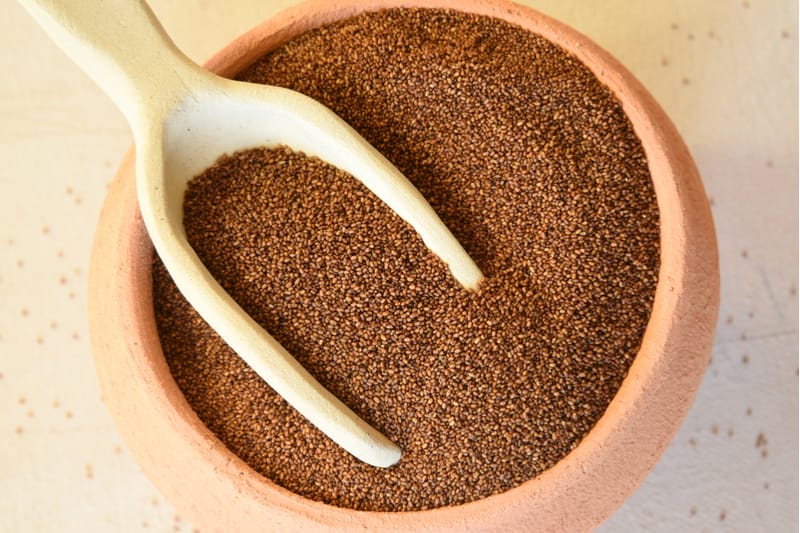
What Makes Teff Special Teff can be grown in virtually any climate and produces an impressively high yield of purple, gray, red, or yellowish brown crops. In fact, all you need to sow a typical field is a handful of teff, and once you have your seeds (which range from dark reddish brown to yellowish brown to ivory in color), teff cooks quickly (it requires only 36 hours to sprout, which is the shortest time of any grain) and uses less fuel than other foods.
Teff is the only ancient grain (or seed) that contains vitamin C, and is both gluten and grain-free, making it an allergy-friendly source of nutrition for many folks.
Teff’s Nutritional Benefits
 Picturepartners/Shutterstock
Want a more in-depth analysis of teff’s nutritional benefits? Allow us to break it down. Per 50-gram dry serving, teff contains 20 percent of your daily recommended dietary allowance (RDA) of iron, 10 percent of your RDA of calcium, 7-grams of protein, 4-grams of fiber, and trace minerals of phosphorus, magnesium, and manganese.
That’s not all. Teff is also known to naturally balance hormone levels, boost immunity, stimulate digestion, strengthen bones, promote cardiovascular health and aid weight loss.
Where to Purchase Teff (And What Kind)
 Lost Mountain Studio/Shutterstock
Teff can be found online at most retailers that sell grains, but if you’re not a big fan of virtual shopping, you should also be able to find teff in health food stores nationwide.
White or ivory teff has the mildest flavor, while the darker varieties provide a more earthy taste. Remember: if you’ve only ever tasted teff in Injera, which is an Ethiopian sourdough flatbread that is used as an edible serving device to sop up lots of delicious Ethiopian stews and condiments, you might assume it only tastes sour — but that’s not the case. When teff is not fermented, it has a sweet and light flavor.
How to Cook Teff
 Claudio Rampinini/Shutterstock
Cooking teff is a simple and fast undertaking. All you need to do is boil some water on your stovetop with a pinch of salt, making sure to use a 3:1 ratio of water (or non-dairy milk) to your teff grain. Once your water reaches a boil, reduce to medium heat, add your teff, and stir your mixture slightly. Then, cook your teff on medium heat for around 15-20 minutes. Once your teff grain has absorbed most of the liquid and softens, you’ll want to turn off your stove and move your pot from the heat source. Put your lid on your pot in order to let your teff grains steam up for about 5-minutes, until it sets.Consume right away since teff can become soggy or too thick (like oatmeal does) if left sitting for too long. It should be soft and creamy, with even a little wiggle room to add more non-dairy milk if you like (for extra creaminess, of course.)
Remember: you want to consume your teff right away because it can actually thicken up too much or become either soggy (sort of the way oatmeal does) if you leave it sitting out for too long.It should be soft and creamy, with even a little wiggle room to add more non-dairy milk if you like (for extra creaminess, of course.)
You know you’ve cooked your teff properly if you’ve achieved a soft and creamy texture. If you’re into extra-creamy teff, feel free to add a splash more of some plant-based milk.
If you have a slow-cooker, you can use the same 3:1 liquid-to-teff ratio, and cook your teff on high for an hour, or on low for two hours.
Use Teff in Your Home Cooking
There are so many different ancient grains out there, it can be a little daunting trying to figure out how to incorporate new ones into your daily diet with ease. Luckily, our Food Monster App is here to help. It’s extremely easy to swap teff in for many staple ingredients you already have in your pantry (and many products you buy could actually already be infused with teff!).
For instance, did you know teff can take the place of quinoa and granola in many oatmeal recipes? Try making this Teff Porridge With Blood Orange and Coconut Butter for a warming morning meal, or cook up a healing batch of this Toasted Turmeric Milk Oat and Teff Porridge for breakfast.
You can grind teff into a flour and use it for an assortment of different purposes. Teff is an essential ingredient in injera (and we suggest dipping your injera in one or all of these 3 Ethiopian Stews) but you could also use teff flour to make Teff Bran Chia Bread or these gluten-free Teff Pancakes With Pomegranate and Pears.
If you’re interested in reading more about ancient grains, or even learning how to make different vegan desserts with them, then we highly recommend downloading our Food Monster App, which is available for both Android and iPhone, and can also be found on Instagram and Facebook. The app has more than 8,000 plant-based, allergy-friendly recipes, and subscribers gain access to ten new recipes per day. Check it out!
Lead image source: Karissaa/Shutterstock