







Girma Berhanu (Professor)
1. Introduction
Recent reports indicate that several armed groups that have been engaged in conflict with the Ethiopian government in different parts of the country have announced an alliance aimed at challenging the government in Addis Ababa. The reported coalition brings together Fano forces in Amhara, the Oromo Liberation Army (OLA), the Tigray People’s Liberation Front (TPLF), and several smaller groups under what has been described as an alliance for survival. The groups have accused Prime Minister Abiy Ahmed’s government of presiding over war, mass destruction, poverty, and other forms of political and humanitarian crisis, and have argued that Ethiopia faces a serious risk of further fragmentation.
I do not dismiss the possibility that political realignment and dialogue among previously antagonistic actors could contribute to a pathway toward peace. Nor do I intend to mock or prematurely judge the emerging alliance. Political conflicts of this magnitude are rarely static, and former adversaries can, under certain circumstances, become partners in pursuit of shared political objectives. At the same time, however, political alliances cannot be understood solely through their immediate strategic calculations. They must also be examined in relation to historical memory, collective trauma, political legitimacy, and the expectations of the communities whose interests the actors claim to represent.
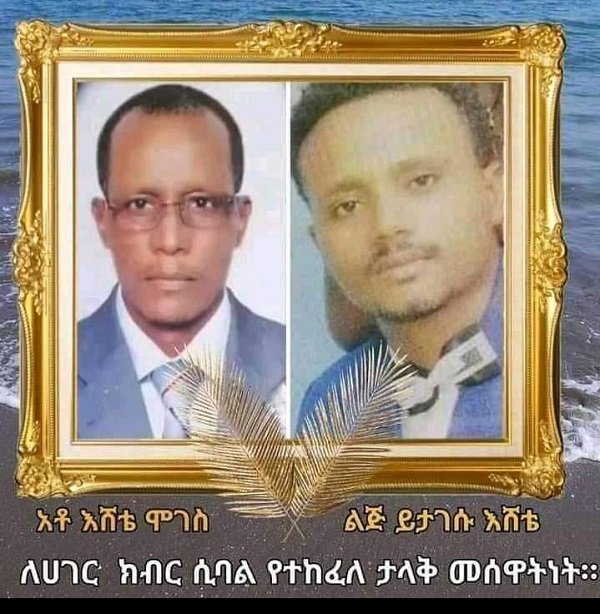
It was in this context that I found myself thinking about Ato Eshete Moges, a Fano leader who died in the Shoa Robit area alongside his son, Yitagesu Eshete. His death, and the circumstances surrounding it, remain deeply significant to me. I was particularly struck by the historical paradox presented by the possibility that a movement associated with his legacy might now cooperate with actors whom many Amhara communities associate with earlier violence and conflict.
This is not an argument that reconciliation is impossible. Nor is it an assertion that historical grievances should make political cooperation permanently unacceptable. Rather, it is an argument for historical consciousness. Reconciliation that simply suppresses memory is fragile; reconciliation that acknowledges past violence, establishes accountability, and articulates clearly defined political principles has a stronger intellectual and political foundation.
For many Amhara families, the violence associated with the conflicts of recent decades remains an unresolved historical experience. Accounts of massacres, displacement, destruction of property, sexual violence, and other alleged abuses have contributed to profound mistrust among communities. These experiences cannot simply be erased by the emergence of a new political configuration. At the same time, historical claims and allegations concerning responsibility for particular acts require careful documentation and should not be transformed into collective accusations against entire ethnic or political communities.
The central questions, therefore, are not simply whether former adversaries can cooperate, but under what conditions such cooperation could become credible and sustainable. What principles would govern the alliance? What mechanisms would address historical grievances? What safeguards would exist against renewed conflict? How would competing political objectives be reconciled? And, perhaps most importantly, what guarantees would be available to the communities whose histories and sacrifices are being invoked in the name of political change?
These questions are particularly important when the memory of individuals such as Ato Eshete Moges continues to shape the political imagination of those who identify with Fano.
2. Ato Eshete Moges: Memory, Sacrifice, and the Meaning of Fano
This article also serves as a commemoration of Ato Eshete Moges and his son, Yitagesu Eshete. Their deaths have acquired symbolic significance within narratives of Fano resistance and sacrifice. Yet commemoration should not simply reproduce heroic mythology. It can also provide an opportunity to examine the values, political assumptions, and historical interpretations that are attached to the memory of those who died.
The purpose of remembering Eshete is not to glorify war or violence. Nor should sacrifice be romanticized as though armed conflict itself produces political or social progress. Rather, the significance of his story lies in the questions it raises about responsibility, family, community, political commitment, and the moral costs of conflict.
The memory of Eshete can therefore be understood as part of a broader political and moral narrative surrounding Fano. In that narrative, Fano is presented not merely as an armed formation but as a social and political consciousness associated with resistance, community responsibility, self-determination, and opposition to perceived injustice. Whether one accepts this interpretation in its entirety or not, it is important to recognize that political movements acquire meaning not only through their organizational structures but also through the collective memories and symbols through which supporters understand them.
This distinction is important at the present historical juncture. If Fano is understood only as an armed organization, then alliances can be assessed primarily in terms of military and strategic interests. If, however, Fano is understood also as a political and moral tradition, then questions of historical memory, political principles, legitimacy, and accountability become unavoidable.
The legacy of Ato Eshete Moges consequently raises a difficult question: what does it mean for a movement to preserve the memory and principles associated with those who sacrificed their lives while simultaneously entering political relationships with former adversaries?
The answer cannot simply be found in loyalty to the past, nor in an unquestioning embrace of the present. It requires a critical engagement with both.
3. The Spirit of Fano and the Problem of Political Identity
One dimension of this discussion concerns the meaning attributed to the term “Fano.” The concept has been interpreted differently across historical periods and political contexts. It has been used to describe forms of local resistance, community mobilization, armed struggle, and broader political consciousness. Consequently, treating Fano as a single, historically uniform entity risks overlooking significant changes in its composition, objectives, and political context.
A more productive approach is to examine the principles that different actors associate with Fano. These may include resistance to perceived oppression, community protection, political autonomy, sacrifice, solidarity, and a commitment to particular understandings of Ethiopian national identity.
The challenge today is to determine whether these principles can provide a coherent political foundation in a rapidly changing environment. Political movements inevitably confront pressures to compromise, form alliances, and adjust their strategies. Such adaptation is not necessarily evidence of betrayal. At the same time, strategic flexibility without clearly articulated principles can create uncertainty about the movement’s political identity and long-term objectives.
This is where the memory of Ato Eshete becomes particularly relevant. His story can be interpreted not simply as a narrative of military courage but as an opportunity to ask what political and ethical commitments should guide those who claim to inherit his legacy.
If Fano is to function as more than an armed formation, it requires a clearly articulated political philosophy. Such a philosophy would need to address questions of citizenship, equality, political representation, minority rights, territorial governance, accountability, and the relationship between ethnic identity and Ethiopian national citizenship.
The issue, therefore, is not whether Fano should cooperate with others in principle. Cooperation can be politically necessary. The more fundamental question is what kind of cooperation is compatible with the movement’s stated principles and with the interests of the wider population.
4. Historical Memory and the Possibility of Reconciliation
The prospect of cooperation among actors with deeply conflicting histories presents a broader theoretical problem. Political reconciliation requires more than a temporary convergence of strategic interests. Durable reconciliation generally depends on some degree of mutual recognition, accountability, institutional guarantees, and a shared understanding of the political future.
Historical memory plays an important role in this process. Communities do not enter political alliances as blank slates. They carry memories of violence, displacement, loss, and betrayal. These memories can influence political behavior long after the immediate conflict has ended.
For this reason, political actors who seek reconciliation must confront rather than simply suppress historical grievances. The alternative is an unstable form of cooperation in which unresolved memories remain beneath the surface and can be activated when political circumstances change.
The question is particularly sensitive in Ethiopia, where political conflict has repeatedly intersected with competing understandings of ethnicity, citizenship, territory, state power, and national identity. A political coalition that brings together organizations with substantially different conceptions of these questions therefore requires more than a declaration of common opposition to the incumbent government. It requires a transparent account of what political order the coalition seeks to establish.
This is also why the memory of Ato Eshete Moges matters. His story represents, for many people, a particular history of sacrifice. That history cannot simply be detached from contemporary political choices. At the same time, historical memory should not become an obstacle to the possibility of reconciliation. The task is to create a political framework in which remembrance and reconciliation are not treated as mutually exclusive.
5. The Present Crossroads
The current political moment presents Ethiopia with profound uncertainty. Political realignment may create new opportunities for negotiation, but it may also produce new tensions when organizations with incompatible objectives attempt to operate within the same political framework.
The central issue is therefore not whether cooperation is inherently legitimate or illegitimate. It is whether the actors involved can establish sufficient agreement concerning the political principles that would govern their cooperation.
Several questions deserve particular attention:
These are not merely strategic questions. They concern the foundations of political legitimacy.
A transition that simply replaces one concentration of power with another would not resolve the structural problems that have contributed to Ethiopia’s recurrent conflicts. A sustainable political settlement would instead require institutions capable of protecting citizens regardless of ethnicity or political affiliation.
6. Toward a Civic Conception of Ethiopian Political Community
My own concern is ultimately broader than the fate of any single political organization. Ethiopia’s political future cannot be secured through competing claims of ethnic ownership over the state. The country belongs to its citizens, and political authority should derive from citizens rather than from exclusive claims that the state belongs to one ethnic group or another.
This principle does not require the denial of ethnic identity. On the contrary, a democratic political order must be capable of accommodating linguistic, cultural, historical, and regional differences while maintaining equal citizenship.
The challenge is to develop a political framework in which ethnic identity and national citizenship are not constructed as mutually exclusive alternatives.
Any future transitional arrangement should therefore be carefully considered. If a transition is required, its legitimacy would depend in part on its independence from the direct control of armed organizations, its civilian character, its representativeness, and its commitment to constitutional and democratic principles. Its purpose should be to establish the conditions for peace, equality, development, accountable government, and democratic participation rather than merely transferring power from one armed or factional group to another.
Ethiopians living abroad also have an important role to play. That role should include critical engagement with information, support for peaceful political processes, documentation of human-rights concerns, and resistance to misinformation. Diaspora political engagement is most constructive when it contributes to informed public debate rather than reinforcing polarization.
7. Final Reflections: What Would Ato Eshete Say?
A recent article by Jeff Pearce, Fano and Forget: The Betrayal of an Ideal, raises serious questions about the reported political realignment and its implications for the identity and historical memory of Fano. Pearce argues that an alliance involving actors associated with previous violence against Amhara communities risks undermining the principles the movement claims to represent. His argument is one interpretation of the current political development, but it reflects a broader concern: can strategic political alliances coexist with historical memory, political principle, and accountability?
As I am finalizing this text, Addis Standard has reported an important clarification from the Oromo Liberation Army (OLA) regarding the emerging alliance among Ethiopia’s opposition armed groups. The OLA has characterized the initiative as a “procedural consensus,” rather than a substantive political agreement, emphasizing that it does not constitute a common position on Ethiopia’s political future or authorize any participating group to speak on behalf of others.
In a press release issued on 17 September, the OLA explicitly stated that it was neither involved in nor a component of the emerging alliance. At the same time, it acknowledged a broader pattern of cooperation among opposition forces, describing a process “stretching from west to east and from south to north.” The distinction is important. It suggests that coordination among opposition forces may be expanding, while the extent to which this coordination represents genuine political convergence remains unresolved. The OLA’s statement therefore highlights a central tension within Ethiopia’s opposition landscape. There may be growing recognition of the need for coordination, but procedural cooperation should not be mistaken for agreement on political objectives, governance arrangements, accountability, or a shared vision for Ethiopia’s future. In a fragmented political environment, claims of opposition unity can easily go beyond the actual level of political consensus.
The question that remains for me is therefore deeply personal, but also profoundly political: What would Ato Eshete Moges say about this emerging political configuration?
We cannot know the answer. Yet the question itself matters because it forces us to confront the uneasy relationship between historical memory and political expediency.
Remembering Eshete should not mean perpetuating a culture of revenge. Nor should honoring his memory require rejecting every possibility of political reconciliation. Rather, his memory can serve as a reminder that political movements are ultimately judged not only by the alliances they form or the power they acquire, but also by the principles they uphold when political circumstances change.
If there is a meaningful legacy to be drawn from his story, it should be one of responsibility: responsibility toward family and community, responsibility toward the wider society, and responsibility for the political consequences of one’s choices.
Ethiopia needs neither the romanticization of armed struggle nor the erasure of historical suffering. It needs a political order grounded in equal citizenship, accountability, constitutional government, peaceful political participation, and respect for human dignity.
The central challenge, therefore, is to move beyond the politics of inherited grievance without erasing the history that produced those grievances. Reconciliation without memory is fragile; memory without reconciliation can become a permanent source of conflict. The difficult task is to hold the two together—to remember without reproducing hatred, and to pursue reconciliation without demanding historical amnesia.
As I think of Ato Eshete Moges and his son, Yitagesu, I am left not with a simple political answer, but with a question that deserves serious public reflection:
What should the living learn from those who died, and how should that memory shape the political choices we make in the present?
References
Berhanu, G. (2022). Fano: A living saviour of the Amhara people and the Ethiopian spirit. Advances in Social Sciences Research Journal, 9(1), 112–119. https://doi.org/10.14738/assrj.91.11537
Eurasia Review. (2025, September 19). Ato Eshete Moges: A lion among men whose courage blazed like fire across Fano. https://www.eurasiareview.com/19092025-ato-eshete-moges-a-lion-among-men-whose-courage-blazed-like-fire-across-fano-oped/
Eshete Moges, Yitagesu Eshte: Valorous father and son paid in life together. (n.d.). Gazette Plus. https://share.google/PUtbTNy7VJp4Bzbxo
Fano: A mass outrage for Amhara existence, justice and Ethiopian unity. (n.d.). https://share.google/166WApR72QNn7zfTb
Fano and forget: The betrayal of an Ethiopian people. (n.d.). Jeff Propulsion. https://jeffpropulsion.substack.com/
The story of fatherhood in the war field of Shewarobit—Ethiopia. (n.d.). The Voice of Africa. https://share.google/PuPVK59lQEIQ7yEqQ
Slovic, P. (2007). [Article title not provided]. Judgment and Decision Making, 2(2), 79–95.
Gazette Plus. (n.d.). [Article title not provided]. https://share.google/ePqSYE9DwKp9sDwAb
YouTube. (n.d.). [Video]. https://youtube.com/watch?v=uwKCTed332Y
ፋኖን እወዳለሁ፥ ፋኖንስ አልጠላ፣
ተኳሽ እወዳለሁ፥ ተኳሽም አልጠላ፣
ሲደክመኝ አርፋለሁ፥ በጎፈሬው ጥላ።
ፋኖ አገሩ ገባ፥ ሳይሰናበተኝ፣
እሸኘው ነበረ፥ ምንም ቢታክተኝ።