







A month before Ethiopia’s elections, opposition activist Getahun Abraham walked into a compound of government offices in the southern town of Gimbichu, doused his body in gasoline and set himself alight. It took more than 10 minutes for bystanders to extinguish the flames.
“We were in a meeting when we heard a scream,” local police chief Moges Bafe recalled of the day the 25-year-old physics teacher committed suicide. “When we ran out, he was burning and we also screamed. The fire looked like a big house was being burned.”
Getahun had become desperate after the authorities rebuffed his requests to transfer him from his home village to Gimbichu and believed the refusals were politically motivated, according to his friend, Teshome Demissie, a hospital cashier.
Little is expected to change on May 24 when Ethiopians vote for federal and regional lawmakers.
‘Big’ Victory
The ruling party “will win big time” because of its development record and better organization, Dereje Feyissa Dori, Africa research director at the International Law and Policy Institute in Norway, said in an e-mailed response to questions. While the opposition is divided and unable to articulate alternative policies, they might gain “at least some protest votes,” he said.
When Getahun joined Medrek, a four-party bloc that forms the main opposition to the ruling EPRDF, his brother Wondimu Abraham warned him he was risking trouble.
“I told him don’t be part of Medrek, don’t get involved, as after a time you will face a problem,” Wondimu, a 30-year-old member of the EPRDF who works at the main court in Gimbichu, about 211 kilometers (131 miles) southwest of the capital, Addis Ababa, said in an interview.
Getahun grew depressed by the authorities’ denial of his repeated requests to be transferred from the school in his family’s village of Humaro, to Gimbichu, 7 kilometers away, Wondimu said.
Political Activity
The chief administrator in Gimbichu, Elias Ersado Benchamo, said local officials weren’t aware of Getahun’s political activity and didn’t receive any transfer requests. Getahun killed himself because he was lovesick, isolated from his family or addicted to the stimulant khat, Elias said in an interview on May 8.
Medrek members say they face routine harassment by the authorities. The U.S., which backs the Ethiopian army’s role in battling al-Qaeda-linked militants in neighboring Somalia, has echoed United Nations’ condemnations of the government’s jailing of activists and journalists.
Ethiopian officials say they only prosecute activists and journalists who break the law.
The nation’s authorities have used “multiple channels” to enforce “political control,” London-based Amnesty International said in a February report. Steps include “politicizing access to job and education opportunities.”
Transform Ethiopia
The four-party EPRDF, with more than 7 million members, says it’s seeking to transform Ethiopia into a middle-income nation by 2025. The state controls strategic economic sectors such as telecommunications.
The party’s dominance was clear in Gimbichu, located in the ethnic Hadiya zone of Ethiopia’s southern region. On a muddy high street of small cafes and barbershops most buildings were plastered with the ruling coalition’s worker-bee symbol. A couple of Medrek posters were also displayed.
A color billboard on Gimbichu’s outskirts showed images of some of the EPRDF’s economic achievements: low-cost housing and a hydropower dam. Infrastructure and social-services spending has helped economic growth average 10 percent over the past decade, the UN Development Programme said this month.
While Ethiopia’s poverty rate fell from 39 percent to 26 percent between 2005 and 2013, a quarter of the country’s 100 million people still live below the UN poverty threshold of $1.25 a day, it said.
Talking Politics
Getahun didn’t believe in the ruling party’s success claims and often stopped people in the countryside to talk about politics.
“He thought the EPRDF used democracy as cosmetics,” Teshome said. “Internally they use dictatorship, and their cover is democracy.”
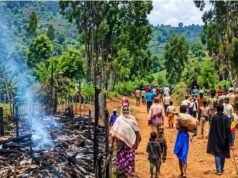
About two weeks after Getahun’s self-immolation, charred scraps of clothing still litter the grass at the government compound. Nearby, he had left cash, a copy of the New Testament, a suicide note and his Medrek membership card, his brother said.
In the five-page letter, Getahun took responsibility for his actions and described his despair over family issues and feelings of persecution.
“Being in politics shouldn’t get you punished this much,” he wrote.